Guide · Phrases
The 50 most useful Mandarin phrases, with audio
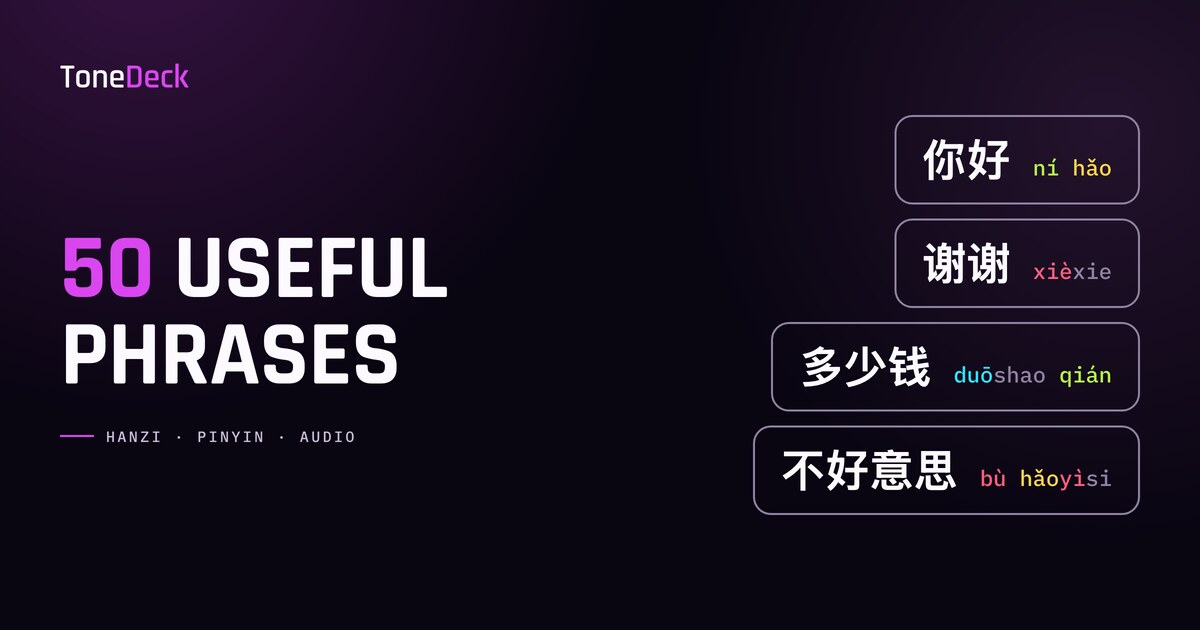
The most useful Mandarin phrases for a beginner are 你好 (nǐ hǎo, hello), 谢谢 (xièxie, thank you), 不好意思 (bù hǎoyìsi, sorry), 请问 (qǐngwèn, excuse me), 多少钱 (duōshao qián, how much) and 我听不懂 (wǒ tīng bu dǒng, I cannot understand). Those six will carry you through a remarkable amount of real life. The other 44 below are grouped by the situation you will need them in, and every one has native audio, so you learn the tones with the words instead of bolting them on later. Tap any phrase to hear it.
Pinyin colours: 1st high-flat, 2nd rising, 3rd low-dipping, 4th falling, grey = neutral. Tap any word to hear it.
How to use this list
Do not try to memorise all fifty in one sitting. Take one group a day, play each phrase three times, say it back out loud, and move on. Phrases with a full page (most of them) include a sentence, a character-by-character breakdown and a tone tip. Numbers are deliberately not in this list; they have their own guide, counting in Chinese 1 to 100.
1. Greetings and goodbyes
Mandarin greetings are shorter and less ritualised than English ones. 你好 works for anyone, at any time of day, and most of the time-specific greetings are optional politeness.
- hello
The universal greeting. Both syllables are third tones, so the first is said as a rising ní: this is the first tone-sandhi rule you meet. Full page →
- good morning
Formal-ish. Between friends and colleagues a bare 早 (zǎo) is more natural. Full page →
- good afternoon
Rarely used in casual speech; you will hear it from staff, announcers and teachers. Full page →
- good night
Said when parting for the night or heading to bed, not as a general evening greeting. Full page →
- goodbye
Literally see again. Two crisp fourth tones. Full page →
- see you tomorrow
Swap 明天 for 下次 (xià cì, next time) or 一会儿 (yíhuìr, in a bit) as needed. Full page →
- long time no see
The English phrase is a calque of this. 不 rises to bú because 见 is a fourth tone. Full page →
2. Courtesy
Chinese speakers say please and thank you less often than English speakers among friends and family, and more often with strangers. Use these freely as a learner: nobody will mind.
- thank you
The second 谢 is a light neutral tone. Giving it a full fourth tone sounds robotic. Full page →
- you're welcome
Literally do not be polite. 不 becomes bú before the fourth-tone 客. Full page →
- sorry
For real apologies. For bumping into someone, 不好意思 below is lighter and more common. Full page →
- no problem / it's okay
The standard reply to an apology. Also it does not matter. Full page →
- please
Put it before a verb: 请坐 (qǐng zuò, please sit), 请进 (qǐng jìn, please come in). Full page →
- excuse me
Literally please ask. The polite opener before any question to a stranger. Full page →
- sorry, excuse me (mild)
The everyday sorry: squeezing past someone, being a minute late, asking a favour. Softer than 对不起.
3. Introductions and small talk
These get you through the first two minutes with anyone. Where are you from and how old are you are normal, friendly questions in Chinese, not intrusive ones.
- how are you
Textbook-standard, though natives more often ask 最近怎么样 (zuìjìn zěnmeyàng, how have things been). Full page →
- my name is
Follow it with your name. 叫 is a sharp fourth tone. Full page →
- what's your name
Literally you called what name. The polite version is 您贵姓 (nín guìxìng, your honourable surname). Full page →
- nice to meet you
Literally very happy to know you. Six syllables, so say it slowly at first. Full page →
- where are you from
Literally you are which country person. Answer with 我是 + country + 人. Full page →
- how old are you
Fine for adults and children among friends. 你多大 is casual; add 了 for softness. Full page →
- I am learning Chinese
Say this early. It sets expectations and people slow down and help. Full page →
- do you speak English
会 means know how to. End with the neutral question particle 吗. Full page →
4. When you did not understand
The most useful phrases in any language are the ones that keep the conversation going when you are lost. Learn these four cold.
- I don't understand
Short and clear. 懂 is a third tone, said low after the fourth-tone 不. Full page →
- I don't know
知道 ends on a fourth tone. Do not confuse with 我不懂: this is about facts, not comprehension. Full page →
- I cannot understand (what I hear)
The precise phrase for spoken language: literally I listen not understand. 不 is neutral inside this pattern.
- please say it again
一 becomes yí before the fourth-tone 遍. Add 慢一点 (màn yìdiǎn, a bit slower) if needed.
5. Yes, no and the basics
Mandarin has no single word for yes or no. You usually repeat or negate the verb in the question, but these five cover most situations.
- yes
Literally is. The default yes when the question used 是; otherwise echo the verb (会, 有, 好). Full page →
- no
Literally is not. 不 rises to bú before the fourth-tone 是. Full page →
- okay, sure
Agreement to a suggestion or instruction. 好 stays low before the neutral 的.
- can, may, that is fine
Two third tones, so the first rises: written kěyǐ, said kéyǐ. Also the answer to can I?
- there is not, I do not have
The negative of 有 (to have). Also the answer to have you...? questions.
6. Food and drink
You will use these more than anything else in the list. Ordering is simple: name the thing, add 一个 or a number, and say 谢谢.
- delicious
Literally good eat. The highest compliment to a cook, and expected at every meal. Full page →
- I am hungry
了 marks the change of state: I have become hungry. Full page →
- water
Ask for 热水 (rè shuǐ, hot water) or 冰水 (bīng shuǐ, iced water); plain 水 often gets you warm water. Full page →
- the check please
Literally buy the bill. Catch the waiter's eye and say it; 结账 (jiézhàng) is the more formal equivalent. Full page →
- cheers
Literally dry cup, so historically it meant finish your drink. Two high flat tones. Full page →
- waiter, waitress
How you call staff over in a restaurant. Not rude: it is the normal way to get attention.
7. Shopping
Markets expect a little back-and-forth; shops with price tags do not. Either way these three cover asking, declining and choosing.
- how much
Literally how much money. 少 is neutral here; 钱 rises. Full page →
- too expensive
Two sharp fourth tones and a light 了. The opening move in any market negotiation.
- I want this one
Point and say it. Swap 这个 for 那个 (nàge, that one). 个 is neutral.
8. Directions and emergencies
Four phrases for when things go wrong. 在哪里 (zài nǎlǐ, where is) can be attached to any noun, not only the toilet.
- where is the toilet
The pattern is noun + 在哪里. 洗手间 (wash-hands-room) is the polite word. Full page →
- I am lost
Literally I have lost the road. Follow with the name of where you are trying to go. Full page →
- help (emergency)
Literally save life. For genuine emergencies only; for asking assistance use the next phrase. Full page →
- please help me
Doubling the verb (帮帮) makes the request softer and more casual. The second 帮 is neutral.
9. Celebrations and feelings
Good wishes are formulaic in Chinese, which makes them easy: 快乐 (kuàilè, happy) attaches to almost any occasion.
- happy birthday
Sung to the same tune as the English song, which makes it easy to remember. Full page →
- happy new year
Works for both 1 January and Lunar New Year. 恭喜发财 (gōngxǐ fācái) is the Lunar New Year classic. Full page →
- congratulations
Often doubled to 恭喜恭喜 for warmth. Full page →
- good luck
Literally wish you good luck. 你 rises to ní before the third-tone 好. Full page →
- I love you
Said less casually than in English; between family it is rarer than the actions that show it. Full page →
- go for it, keep going
Literally add fuel. Shouted at sports, said to friends before exams. The all-purpose encouragement.
Three things to notice across the whole list
不 keeps changing
It is bù before most syllables but rises to bú before a fourth tone: 不是, 不客气, 不见. Inside a verb pattern like 听不懂 it goes neutral.
Third tones rarely dip
Before another syllable, 你, 我, 好 and 请 are said low and short, and before another third tone they rise. See the half-third guide.
The last syllable is often light
谢谢, 多少钱, 什么, 我们: the neutral tone shows up in an enormous share of everyday words. Do not give it a full tone.
If any of those three surprised you, read Mandarin tones explained and the third tone is lying to you, then check what you can actually hear with the free tone test. For the full set of phrase pages, including several not on this list, browse how to say it in Chinese, and for the vocabulary behind them start with the HSK 1 word list.
Frequently asked questions
What are the most useful Mandarin phrases for a beginner?+
Start with 你好 (nǐ hǎo, hello), 谢谢 (xièxie, thank you), 不好意思 (bù hǎoyìsi, sorry / excuse me), 请问 (qǐngwèn, excuse me, may I ask), 多少钱 (duōshao qián, how much) and 我听不懂 (wǒ tīng bu dǒng, I cannot understand). Those six carry a surprising share of real conversations.
How do I say yes and no in Chinese?+
Mandarin has no single word for yes or no. You normally repeat the verb from the question to agree, or put 不 (bù) or 没 (méi) in front of it to disagree. 是 (shì) and 不是 (bú shì) work when the question used 是, and 好的 (hǎo de) means okay.
Do I need the tones to be understood?+
Yes. The tone is part of the word, so 买 mǎi (buy) and 卖 mài (sell) are different words. Every phrase on this page has audio so you can copy the real tone rather than guess it from the letters.
Why is 你好 pronounced ní hǎo?+
Both syllables are third tones, and when two third tones meet the first is said as a rising second tone. The dictionary spelling stays nǐ hǎo, but the sound is ní hǎo. The same rule applies to 很好 (hén hǎo) and 可以 (kéyǐ).