
Guide · Pinyin
Pinyin pronunciation guide: the sounds English speakers get wrong
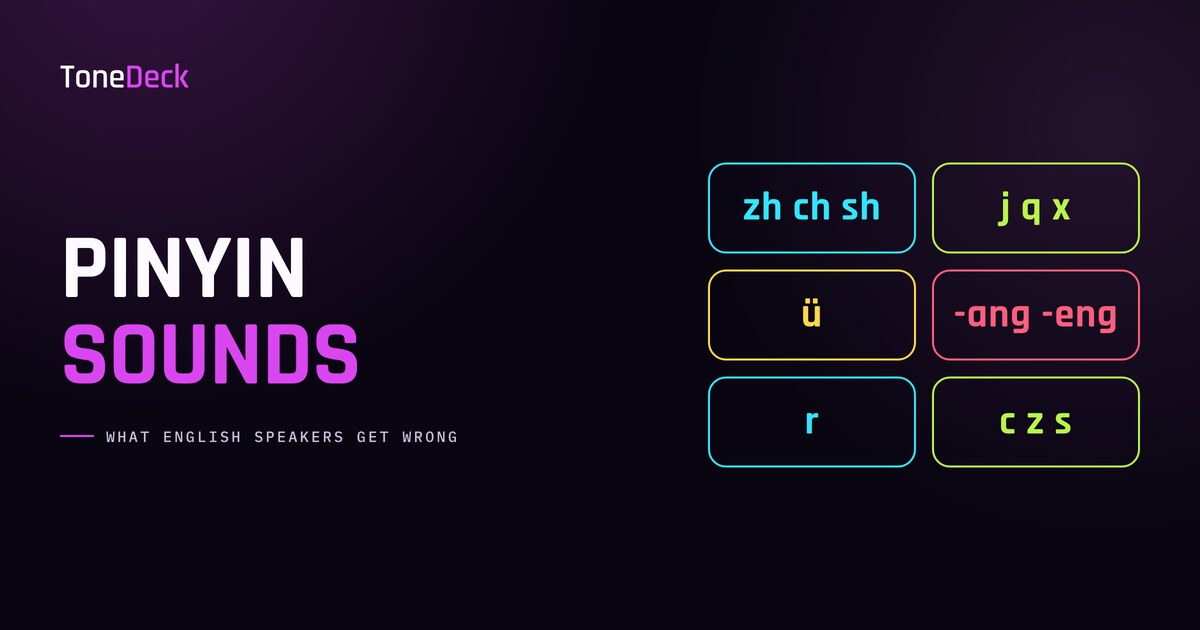
Pinyin uses the Latin alphabet, but many of its letters do not sound the way they do in English: q is closer to ch, x to sh, c to ts, and zh, ch and sh are said with the tongue curled back. Pinyin was designed as a consistent spelling system for Mandarin, not as a phonetic guide for English readers, so every letter has exactly one job and some of those jobs are surprising. This guide walks through the six sound groups that trip up English speakers most, with a native recording for every example so you can copy the real thing rather than an approximation.
Pinyin colours: 1st high-flat, 2nd rising, 3rd low-dipping, 4th falling, grey = neutral. Tap any word to hear it.
1. zh, ch, sh (tongue curled back) versus j, q, x (tongue flat)
This is the pair of sound families that causes the most trouble, because English has one set of sounds (j, ch, sh) sitting roughly between the two Mandarin sets. Mandarin splits them. For zh, ch and sh (and their voiced cousin r), curl the tip of your tongue up and back towards the roof of your mouth, further back than for English sh. The result is darker and duller than English, and the vowel that follows a bare zh, ch, sh or r written as i is not ee at all: it is a buzzy continuation of the consonant.
For j, q and x, do the opposite: keep the tongue tip down behind your lower teeth and push the flat blade of the tongue up towards the hard palate, close to where English y is made. Spread your lips a little as if smiling. The sounds are bright and light. q is a ch made in that position, and x is a soft, hissy sh, halfway to an s.
The spelling gives you a free hint: j, q and x are only ever followed by i or ü, and zh, ch, sh never take that clear ee vowel. So if you see ji, the i is a real ee; if you see zhi, it is the buzz. Tap each pair and listen for the difference in both the consonant and the vowel after it.
2. The ü vowel, and where it hides
English has no ü, so most learners replace it with oo and get a different word. The recipe: say a long ee, keep your tongue exactly where it is, and round your lips into an oo shape. That is ü. You will feel it in the front of your mouth, whereas oo lives at the back. The written dots appear only after n and l, because those are the only consonants that can take both u and ü: 路 lù (road) and 绿 lǜ (green) are different words.
The trap is that after j, q, x and y the dots are dropped in spelling but the sound is still ü. There is no plain oo after those letters, ever. So qu, xue, yu and yue all contain the front rounded vowel, and pronouncing 去as “choo” is one of the most recognisable foreign accents in Mandarin.
3. -an versus -ang, -en versus -eng
English speakers tend to hear these as the same vowel with a slightly different ending. In Mandarin the vowel itself changes. The -an of 山 is a fairly open ah with the tongue tip landing on the ridge behind your teeth; the -ang of 上 is a deeper, further-back ah that ends with the tongue lifted at the back, as in English song. Do not add a hard g: the ng is the whole ending.
-eng is the one nobody expects. It is not the eng of English. The vowel is the uh of sofa, so 风 fēng sounds like fung and 冷 lěng like lung. And -ong is closer to oong than to the o of song.
4. The letter r
At the start of a syllable, pinyin r is not the English r. It is the voiced partner of sh: same curled-back tongue, but with the voice switched on and no lip rounding at all. Some speakers make it closer to the s in measure, others closer to a dull English r; either is understood, but the rounded, growly American r is not. Keep your lips relaxed and the tongue tip back.
At the end of a syllable, -r is a different thing entirely: the northern 儿 suffix, which curls the tongue on the vowel and often swallows the final consonant. 哪儿 nǎr (where) sounds like nar, not na-er. You will hear it constantly in Beijing and much less in the south.
5. c, z and s
Pinyin c is never k and never s. It is ts, as at the end of cats, released with a puff of air. z is the same tongue position without the puff, like the ds in kids. The difference between them is aspiration (the breath), not voicing, which is why 菜 and 在 sound closer to each other than English ts and dz do. s is a normal s. All three take the buzzing i when written ci, zi, si, but it is a different buzz from the one after zh, ch, sh: flatter, with the tongue tip forward behind the teeth.
The classic beginner mix-up is 四 sì (four) and 十 shí (ten): a flat-tongue s versus a curled-tongue sh, and a falling tone versus a rising one. It matters when you are paying for something. See counting in Chinese 1 to 100.
6. Smaller traps worth knowing
A handful of vowels and finals are spelt in a way that hides their real sound. None of these is hard once you know it is there.
| Pinyin | Actually sounds like | Hear it |
|---|---|---|
| e | uh, as in the second syllable of sofa, never eh | |
| -ian | yen, not yan | |
| -ui | way, the e is hidden | |
| -iu | yoh, the o is hidden | |
| -un | wun, as in won | |
| b, d, g | unaspirated, closer to p, t, k without the puff of air | |
| p, t, k | aspirated, with a strong puff of air |
The tone mark is part of the spelling
Everything above is about consonants and vowels, and you can get all of it right and still say the wrong word, because the mark over the vowel is not optional. 买 mǎi (buy) and 卖 mài (sell) share every letter. If tones are new to you, read Mandarin tones explained next, then check your ear with the free tone test. To drill the letter-to-sound mapping itself, the pinyin match game plays a word and asks you to pick its pinyin, which is the fastest way to stop reading pinyin as if it were English. Every word in the HSK 1 vocabulary list has audio, so you can check any syllable you are unsure about.
Frequently asked questions
Is pinyin pronounced the same as English letters?+
No. Pinyin borrows the Latin alphabet but assigns several letters different sounds. The biggest surprises for English speakers are q (like ch), x (like a soft sh), c (like ts), zh (a curled-tongue j), and the ü vowel. The vowel letters also shift depending on the final they sit in.
What is the difference between zh, ch, sh and j, q, x?+
zh, ch and sh are said with the tongue tip curled back towards the roof of the mouth (retroflex). j, q and x are said with the tongue flat and the blade pressed towards the hard palate, close to the position for English y. The two sets never appear before the same vowels: j, q, x are only followed by i or ü, and zh, ch, sh never take that clear ee sound.
How do you pronounce ü in pinyin?+
Say ee as in see, hold your tongue exactly there, then round your lips as if to say oo. The result is the ü of nǚ (woman) and lǜ (green). After j, q, x and y the two dots are dropped in spelling but the sound is still ü, so qù (go), yú (fish) and xué (study) all contain it.
Why does the i in shi and si not sound like ee?+
After zh, ch, sh, r and after z, c, s the letter i does not stand for the ee vowel. It marks a buzzing continuation of the consonant, roughly the sound you make if you try to hum through the sh or s position. Everywhere else, i is a clear ee as in jī (chicken).
Do I need tones to pronounce pinyin correctly?+
Yes. The tone mark is part of the spelling: mǎi (buy) and mài (sell) are different words. Getting the consonants and vowels right without the tone is only half the pronunciation.