
Guide · Tone mistakes
12 Chinese tone mistakes that change the meaning
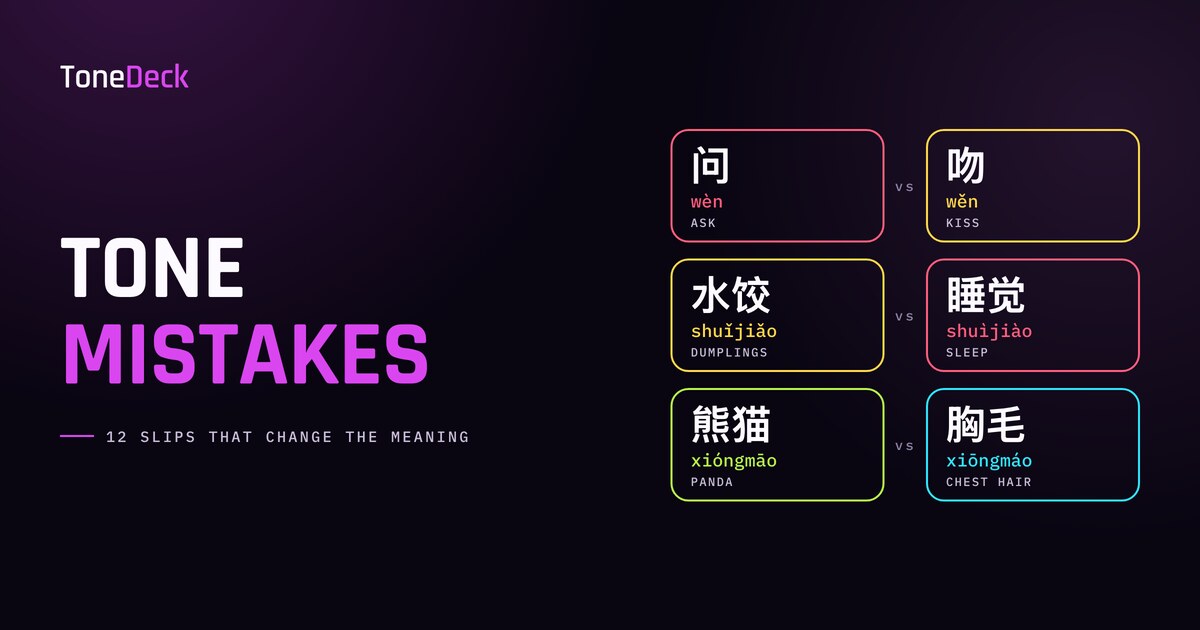
In Mandarin the tone is part of the word, so one wrong pitch turns ask into kiss, dumplings into sleep and panda into chest hair. These are not textbook curiosities: every pair below is a genuine minimal pair that learners mix up in real conversations, usually in front of someone they were trying to impress. Each card has native audio for both words, the sentence you meant, the sentence they heard, and the one contour to listen for. Tap any word to hear it, and share the one you have personally committed.
Pinyin colours: 1st high-flat, 2nd rising, 3rd low-dipping, 4th falling, grey = neutral. Tap any word to hear it.
01to ask becomes to kiss
#- What you meant
I want to ask you something
- What they heard
I want to kiss you
The fix. Every learner does this one, usually to a teacher, a shop assistant or a future mother-in-law. wèn is a fourth tone: start high and drop like a stamp. wěn is a third tone: start low and stay down. The polite opener 请问 qǐngwèn (excuse me, may I ask) turns into 请吻 (please kiss) the same way, which is a strong start to a conversation with a stranger.
02mum becomes horse
#- What you meant
I love my mum
- What they heard
I love my horse
The fix. The textbook example, and it is in every textbook because the four tones on ma are four different words. Mum is a high, flat first tone, sung on one note. Horse is low. If your pitch sags at all on mā, you have insulted a family member and complimented a farm animal. Drill all four on the dedicated page and you will never mix them again.
03boiled dumplings becomes to sleep
#- What you meant
How much for a bowl of dumplings?
- What they heard
How much for a night of sleep?
The fix. The most famous tone joke in Chinese, and it works because 碗 (bowl) and 晚 (night) are also the same syllable. Dumplings are two third tones, so the first one rises and the second stays low: written shuǐjiǎo, said shuíjiǎo. Sleep is two sharp fourth tones. If both syllables come out falling, the waiter hears the second sentence.
04soup becomes sugar, sweets
#- What you meant
I would like soup
- What they heard
I would like sugar
The fix. A full set of four, all of which can come up at the same dinner table: the soup, the sugar, lying down afterwards, and the warning that the soup is too hot. Soup is a first tone: hold it high and flat, longer than feels natural. If your voice climbs at all you have ordered sweets. The pair to practise is 1 versus 2, because English speakers let a flat tone drift upwards without hearing it.
05panda becomes chest hair
#- What you meant
I really like pandas
- What they heard
I really like chest hair
The fix. Same two syllables, tones swapped. Panda is rising then high (2 + 1); chest hair is high then rising (1 + 2). The trick is to hear the pair as one shape rather than two separate tones: for panda your pitch climbs on xióng and then parks up high on māo. If it starts high and climbs on the second syllable, you have changed the subject.
06to buy becomes to sell
#- What you meant
I want to buy it
- What they heard
I want to sell it
The fix. The one that costs money. Buy is a low third tone, sell is a falling fourth, and the words are opposites, so a shopkeeper cannot guess from context. Native speakers keep them apart by where the syllable starts: mǎi starts at the bottom of your range and stays there, mài starts at the top and drops. Say buy in a low, slightly creaky voice and you will be understood.
07eyes becomes glasses
#- What you meant
Your eyes are beautiful
- What they heard
Your glasses are nice
The fix. A compliment that lands very differently. The only difference is the second syllable: in eyes it is a light neutral tone, short and unstressed, while in glasses it is a full fourth tone that falls hard. Learners tend to give every syllable a full tone, which is exactly what turns eyes into eyewear. Let the jing in eyes go soft and quick.
08cup becomes quilt
#- What you meant
I would like a cup
- What they heard
I would like a quilt
The fix. Asked for at hotel reception, this one produces a genuinely confused look, because both requests are reasonable. Cup is a high flat first tone; quilt is a fourth tone that falls from the same height. The difference is entirely in whether the pitch moves. Hold bēi level and slightly long; if it drops at the end, you are getting bedding.
09spouse (of many years) becomes boss
#- What you meant
I really love my wife (or husband)
- What they heard
I really love my boss
The fix. Both words start with 老 (old), and the second syllable decides who you are in love with. Spouse ends in a falling fourth tone. Boss ends in a third tone, and because 老 is also a third tone the word is said láobǎn with a rise on the first syllable (the 3-3 rule). So the whole shape changes: spouse goes low then falls, boss goes up then low.
10Chinese (language) becomes Korean (language)
#- What you meant
I am learning Chinese
- What they heard
I am learning Korean
The fix. The sentence you will say more than any other as a beginner, and a rising tone on the first syllable sends you to the wrong country. 汉 (Han, Chinese) is a fourth tone that falls; 韩 (Han, Korean) is a second tone that rises. Practise the sentence with a firm downward Hàn, as if you were stamping the word.
11fish becomes rain
#- What you meant
I like eating fish
- What they heard
I like eating rain
The fix. Fish rises, rain stays low, jade falls. The 2 versus 3 confusion here is the single most common tone error English speakers make, because a full third tone also ends with a rise. The fix is to remember that in real speech the third tone usually does not rise at all: rain is just low. If you hear yourself going up, it is a fish.
12four becomes to die
#- What you meant
I would like four
- What they heard
I am going to die
The fix. The reason Chinese buildings skip the fourth floor: four and death are one tone apart. Four is a fourth tone (easy to remember) that falls sharply; death is a low third tone. Ordering four of anything with a low, dipping sǐ is the quickest way to make a waiter laugh. Snap the pitch downwards on sì and you are back to counting.
Why these mistakes keep happening
Look at the twelve cards and a pattern shows up. Almost every slip is one of three confusions: a first tone drifting upward into a second (soup into sugar, panda into chest hair), a third tone rising when it should stay low (rain into fish, buy into something that sounds like bury), or a fourth tone that does not fall hard enough (ask into kiss, four into death). English uses pitch for emotion, not meaning, so your ear was never trained to hear these as different words. It can be, quickly, but only by listening to native audio and being told whether you got it right.
- 1
Find out which pairs you cannot hear
The free tone test plays real syllables and scores you on each tone. Most people discover one specific confusion, and that is the one to drill.
Take the free tone test → - 2
Drill two-syllable words, not single tones
Ten of the twelve mistakes above live inside two-syllable words. The tone pairs game trains the twenty combinations with instant audio.
Play the tone pairs game → - 3
Learn what the third tone really sounds like
Half of these confusions involve the third tone, and most learners are still pronouncing it the way the textbook diagram shows. It is usually just low.
Read the half-third guide →
Frequently asked questions
Do tones really matter that much in Mandarin?+
Yes. Mandarin has a small set of syllables and the tone is part of the word, not decoration on it, so wèn (ask) and wěn (kiss) are as different to a native speaker as ask and kiss are to you. Context rescues you sometimes, but in short sentences like the ones on this page there is nothing to rescue you.
Which tone mistake do English speakers make most?+
Confusing the second and third tones (fish yú versus rain yǔ, panda versus chest hair). Both seem to go up, but the third tone in real speech is usually just low with no rise, while the second tone starts mid and climbs. Letting a first tone drift upward into a second tone (soup tāng versus sugar táng) is the next most common.
Why does 水饺 (dumplings) sound like 睡觉 (sleep)?+
They share the same consonants and vowels, shuijiao, and differ only by tone: dumplings is written with two third tones (pronounced shuíjiǎo because of the 3-3 rule) and sleep is two fourth tones (shuìjiào). A learner who lets both syllables fall has said sleep.
How do I stop making tone mistakes?+
Train your ear before your mouth. If you cannot hear the difference between two tones you cannot reliably produce it. Take a tone test, drill minimal pairs like the ones here with native audio, and record yourself saying two-syllable words rather than single syllables, since most real mistakes happen inside words.