
Guides
Learn Mandarin Tones
Plain-English guides to the Mandarin that learners need in real life. Start with tones, build a practice routine, understand your HSK path, then explore the slang textbooks skip.

Mandarin Tones Explained (1st–4th + Neutral)
What each of the four tones sounds like, how the pitch moves, the tone marks, and worked examples like mā / má / mǎ / mà.
Read the guide →
How to Practice Chinese Tones
A step-by-step routine — ear training, minimal pairs, shadowing, record-and-compare, and spaced repetition — plus a sample 15-minute daily session.
Read the guide →
Common Mandarin Tone Pairs and How to Hear Them
Real speech happens in tone pairs. The high-frequency patterns, the ones learners confuse most, and how to drill them by ear.
Read the guide →
How to Remember Chinese Tones: 7 Techniques That Work
Tone colours, minimal pairs, ear training, shadowing, tone pairs, mnemonics, and spaced repetition - the techniques that actually make tones stick, with audio.
Read the guide →
How Long Does It Take to Learn Chinese?
An honest timeline by goal - travel basics to fluency - by HSK level and study hours, plus what speeds it up for English speakers.
Read the guide →
Chinese Swear Words: 22 Mandarin Curses Explained
Characters, tone-marked pinyin, plain-English meanings, severity and the cultural context behind the Mandarin curses textbooks leave out.
Read the guide →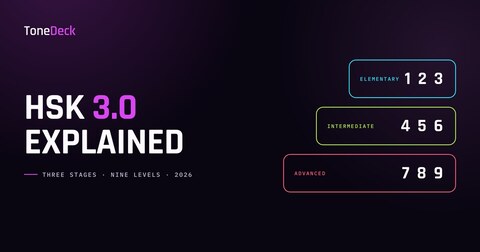
HSK 3.0 Explained: What Changes in 2026
The current rollout status, three-stage nine-level framework, official vocabulary targets, new skills and what learners should study now.
Read the guide →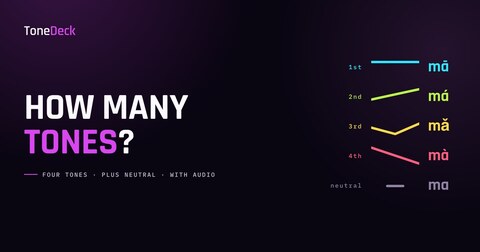
How Many Tones Does Mandarin Have?
Four tones plus a neutral tone. The pitch contours, why the neutral tone counts, how Mandarin compares with Cantonese, and audio for every example.
Read the guide →
The Third Tone Is Lying to You: The Half-Third
The third tone is drawn as a dip-and-rise but is usually a low half-third in speech. When it rises, when it stays low, the 3-3 rule, and drills with audio.
Read the guide →
Pinyin Pronunciation Guide for English Speakers
The sounds English speakers get wrong: zh, ch, sh versus j, q, x, the ü vowel, -ang and -eng, r, c and z, each with tap-to-hear examples.
Read the guide →
Counting in Chinese 1 to 100
Every number with characters, tone-marked pinyin and audio, plus the 一 tone change, 二 versus 两, and the 十 and 百 patterns.
Read the guide →
The 50 Most Useful Mandarin Phrases
Greetings, courtesy, introductions, food, shopping, directions and emergencies: fifty phrases with hanzi, pinyin, audio and a note on when to use each.
Read the guide →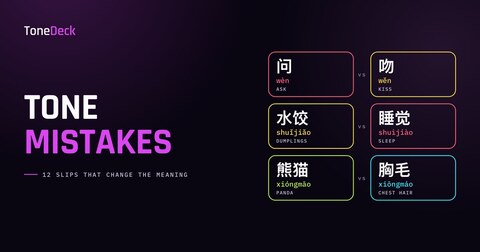
12 Chinese Tone Mistakes That Change the Meaning
Ask becomes kiss, dumplings become sleep, panda becomes chest hair. Twelve real minimal pairs learners confuse, with audio, the sentence they heard and the fix for each.
Read the guide →