Guide · Numbers
Counting in Chinese 1 to 100: pinyin, audio and the tone traps
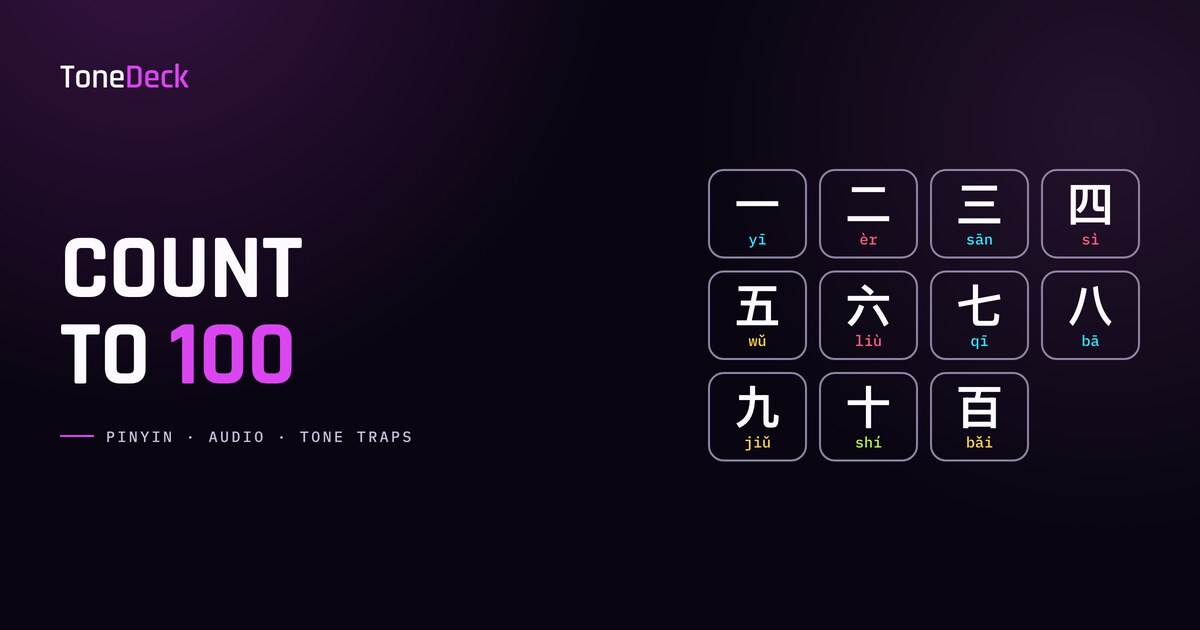
Chinese numbers from 1 to 100 are built from just eleven characters, 一 二 三 四 五 六 七 八 九 十 and 百, combined by a simple times-and-plus pattern: 二十三 is two-ten-three, 23. There are no irregular words like eleven or forty, so once you can say ten things you can say a hundred. The catch is pronunciation: one number changes its tone, two numbers are easy to confuse, and two has a second word. This guide gives you every number with audio and then deals with those traps one at a time.
Pinyin colours: 1st high-flat, 2nd rising, 3rd low-dipping, 4th falling, grey = neutral. Tap any word to hear it.
One to ten
Learn these ten with their tones attached, because every larger number is made of them. Notice the mix: four first tones, three fourth tones, two third tones and one second tone. That variety is why counting aloud is such a good tone workout. Each one has its own page with a sentence, a tone tip and a character breakdown.
| Number | Hear it | Tone | Page |
|---|---|---|---|
| 1 | 1st, high | one in Chinese | |
| 2 | 4th, falling | two in Chinese | |
| 3 | 1st, high | three in Chinese | |
| 4 | 4th, falling | four in Chinese | |
| 5 | 3rd, low | five in Chinese | |
| 6 | 4th, falling | six in Chinese | |
| 7 | 1st, high | seven in Chinese | |
| 8 | 1st, high | eight in Chinese | |
| 9 | 3rd, low | nine in Chinese | |
| 10 | 2nd, rising | ten in Chinese |
Zero is . You need it for phone numbers, room numbers and numbers like 105 (一百零五, one hundred zero five), but not for anything from 1 to 100.
Eleven to nineteen: ten plus something
Say 十 shí and add the units digit. 11 is ten-one, 12 is ten-two, and so on. There is no leading one: 11 is 十一, never 一十一. In pinyin the syllables are joined into one word, and 12 takes an apostrophe (shí'èr) because the second syllable starts with a vowel.
Twenty to ninety-nine: digit, ten, digit
From 20 upwards the pattern is tens-digit + 十 + units-digit. Twenty is two-ten (二十), thirty is three-ten, and 99 is nine-ten-nine. Round tens simply stop after 十. That is the whole system: no -ty, no -teen, no twelve.
A small pronunciation note that makes you sound natural: the third-tone digits 五 and 九 are said as a low half-third when something follows them, so 50 is a low wǔ followed by a rising shí, not a dip-and-rise on each syllable. The full explanation is in the third tone is lying to you.
The full table: 1 to 100 with audio
Every number, with characters and tone-coloured pinyin. Tap any cell to hear it. A good drill is to count aloud in tens, then backwards, then in odd numbers only, checking yourself against the audio whenever a tone feels uncertain.
| # | Chinese and pinyin | # | Chinese and pinyin |
|---|---|---|---|
| 1 | 51 | ||
| 2 | 52 | ||
| 3 | 53 | ||
| 4 | 54 | ||
| 5 | 55 | ||
| 6 | 56 | ||
| 7 | 57 | ||
| 8 | 58 | ||
| 9 | 59 | ||
| 10 | 60 | ||
| 11 | 61 | ||
| 12 | 62 | ||
| 13 | 63 | ||
| 14 | 64 | ||
| 15 | 65 | ||
| 16 | 66 | ||
| 17 | 67 | ||
| 18 | 68 | ||
| 19 | 69 | ||
| 20 | 70 | ||
| 21 | 71 | ||
| 22 | 72 | ||
| 23 | 73 | ||
| 24 | 74 | ||
| 25 | 75 | ||
| 26 | 76 | ||
| 27 | 77 | ||
| 28 | 78 | ||
| 29 | 79 | ||
| 30 | 80 | ||
| 31 | 81 | ||
| 32 | 82 | ||
| 33 | 83 | ||
| 34 | 84 | ||
| 35 | 85 | ||
| 36 | 86 | ||
| 37 | 87 | ||
| 38 | 88 | ||
| 39 | 89 | ||
| 40 | 90 | ||
| 41 | 91 | ||
| 42 | 92 | ||
| 43 | 93 | ||
| 44 | 94 | ||
| 45 | 95 | ||
| 46 | 96 | ||
| 47 | 97 | ||
| 48 | 98 | ||
| 49 | 99 | ||
| 50 | 100 |
Trap 1: 一 (yī) changes tone
On its own, when counting, and at the end of a number, 一 is a high first tone, yī. But when it comes directly before another syllable, it changes: before a fourth tone it becomes a rising second tone (yí), and before a first, second or third tone it becomes a falling fourth tone (yì). Inside 1 to 100 this bites exactly once, at 100 itself: 一百 is written yībǎi and said yìbǎi. Outside counting it bites constantly, because 一 precedes almost every measure word.
One more twist: when reading digits one at a time, in phone numbers, room numbers and bus routes, 一 is often said yāo so it cannot be confused with qī (seven) over a bad line. The same rule for 不 and the full third-tone rule are on the tone sandhi page.
Trap 2: 二 (èr) versus 两 (liǎng)
Chinese has two words for two. 二 èr is the number: it is what you say when counting, doing maths, reading a phone number, and inside every compound number (12, 20, 22, 92). 两 liǎng is the quantity: it is what you say before a measure word when you mean two of something. So you count 一、二、三 but you order 两杯 (two cups). Saying 二个 is one of the clearest beginner giveaways. For 200 the usual form is 两百, although 二百 is also heard, and for 2,000 and 20,000 you use 两.
Trap 3: 四 (sì) and 十 (shí)
Four and ten are separated by two things English speakers find hard: the flat-tongue s versus the curled-tongue sh, and a falling tone versus a rising one. Get either wrong and 14, 40 and 44 blur into each other, which is a problem when money is involved. Practise them as a set until the difference is automatic; the tongue positions are explained in the pinyin pronunciation guide.
The 十 and 百 patterns, in one place
10 stands alone
十 shí is ten by itself. You never say 一十 for 10, and 11 to 19 start straight with 十.
Tens are digit + 十
二十 20, 三十 30 ... 九十 90. Add the units digit after 十 for 21 to 99.
100 needs the one
一百 (yìbǎi). Unlike 十, 百 is never used alone for 100, and 一 takes its changed tone before it.
Two before 百 is usually 两
两百 for 200. Inside 1 to 100, though, two is always 二: 十二, 二十, 二十二.
Numbers are among the first words on the HSK 1 vocabulary list (the larger numbers, days and dates are on the Chinese numbers vocabulary page), and they are the best possible material for tone practice, because you already know what they mean and can focus entirely on pitch. Count to a hundred out loud once a day for a week, then take the free tone test to see whether your ear has caught up with your mouth.
Frequently asked questions
How do you count from 1 to 10 in Chinese?+
一 yī (1), 二 èr (2), 三 sān (3), 四 sì (4), 五 wǔ (5), 六 liù (6), 七 qī (7), 八 bā (8), 九 jiǔ (9), 十 shí (10). Every number up to 99 is built from these ten characters.
How do Chinese numbers from 11 to 99 work?+
Say the tens digit, then 十 (shí, ten), then the units digit. 23 is 二十三 èrshísān, literally two-ten-three. For 11 to 19 you drop the leading one: 11 is 十一 shíyī, not 一十一. Round tens drop the units: 30 is 三十 sānshí.
Why does 一 (yī) change tone?+
一 is first tone (yī) on its own, at the end of a number, and when reading digits. Before a fourth tone it becomes second tone (yí), as in 一个 yí ge. Before a first, second or third tone it becomes fourth tone (yì), as in 一百 yìbǎi and 一天 yìtiān. Standard pinyin usually writes the original yī and expects you to apply the change when speaking.
When do you use 二 (èr) and when 两 (liǎng)?+
Use 二 (èr) for the number two when counting, in maths, in phone numbers and inside compound numbers like 十二 (12) and 二十 (20). Use 两 (liǎng) when saying two of something with a measure word: 两个人 liǎng ge rén (two people), 两杯 liǎng bēi (two cups). For 200, 两百 liǎngbǎi is the usual form.
How do you say 100 in Chinese?+
一百, written yībǎi and pronounced yìbǎi. Unlike English, Chinese always states the one: 百 alone is not used for 100 the way 十 alone is used for 10.