Guide · Mandarin tones
How many tones does Mandarin have?
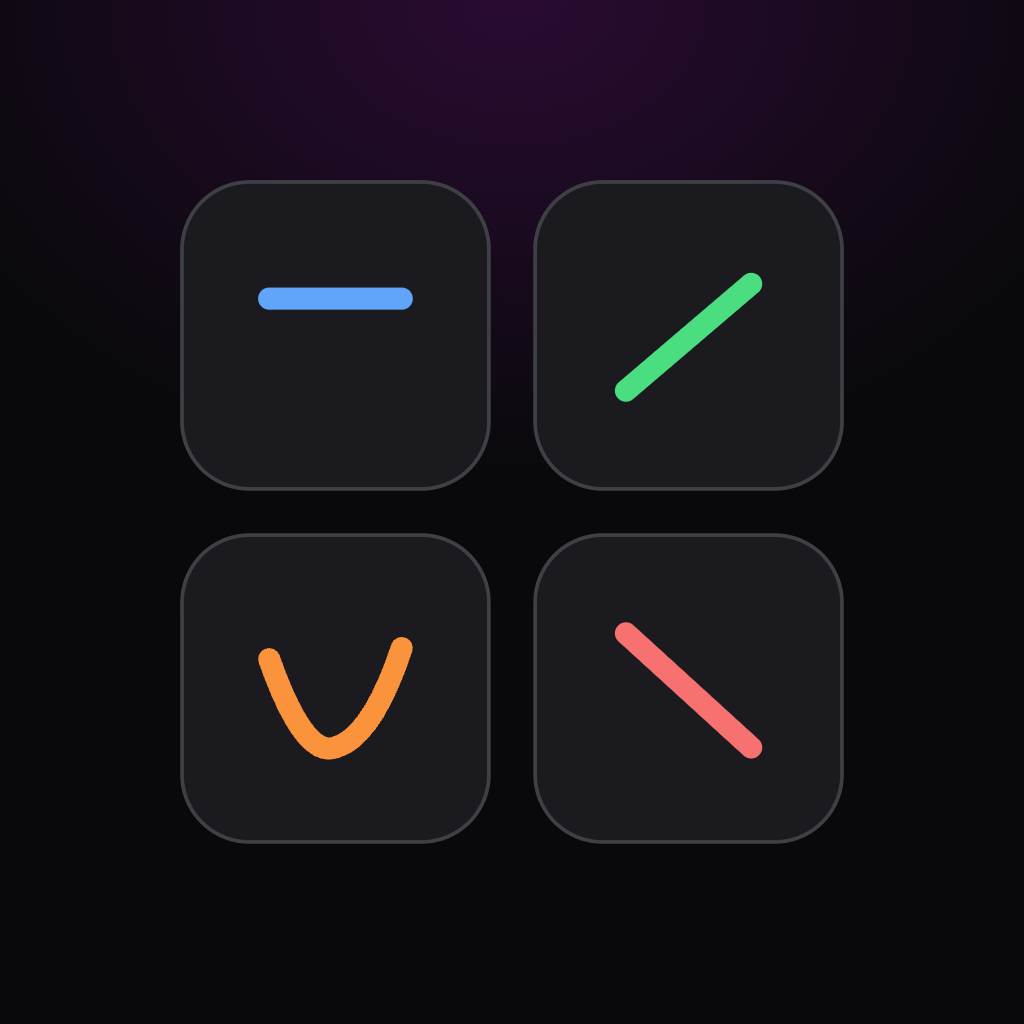
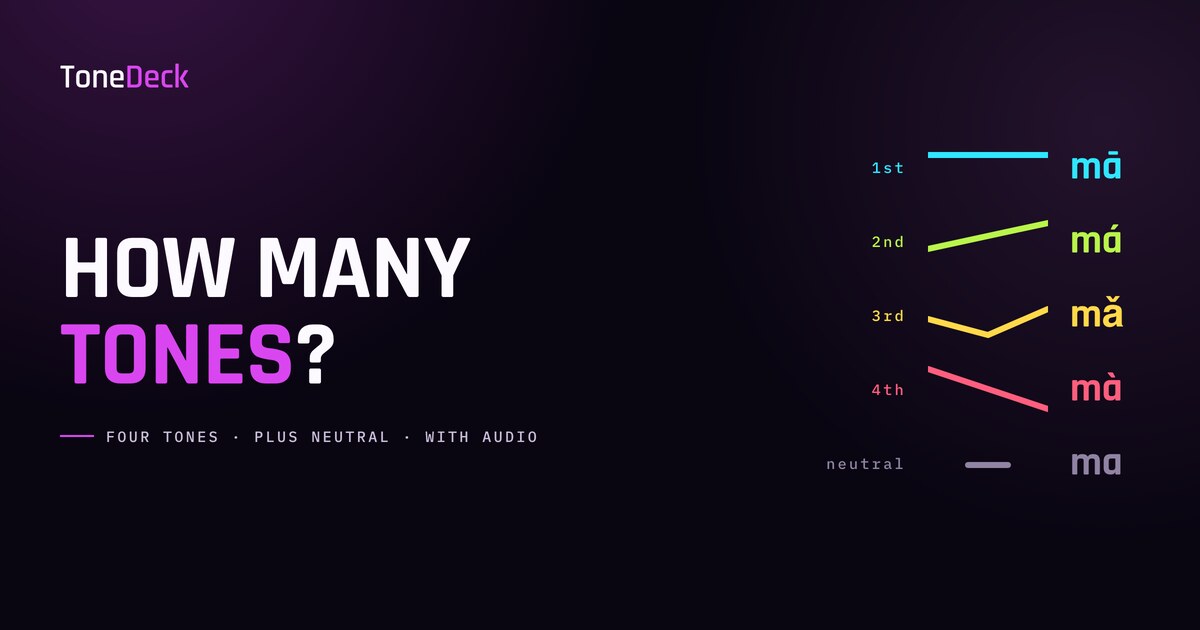
Mandarin has four tones plus a neutral tone. The four full tones are high-level, rising, low-dipping and falling, and every stressed syllable carries one of them. The neutral tone is a short, light syllable with no pitch shape of its own. Whether you call that four tones or five depends on how you count, and this guide explains both answers, with audio for every example.
Pinyin colours: 1st high-flat, 2nd rising, 3rd low-dipping, 4th falling, grey = neutral. Tap any word to hear it.
The five at a glance
Linguists describe each tone with a pair of numbers from 1 (the bottom of your speaking range) to 5 (the top). A first tone written 55 starts high and stays high; a fourth tone written 51 starts at the top and drops to the bottom. You do not need to memorise the numbers, but they make it obvious that the four tones are four different pitch movements, not four different sounds.
First tone
pitch 55 · high and levelA steady high pitch held for the whole syllable, like singing one sustained note. Nothing rises, nothing falls.
Second tone
pitch 35 · risingStarts in the middle of your range and climbs to the top, like the lift on an English question: what?
Third tone
pitch 214 · low, dippingDrops to the bottom of your range and, when the syllable is on its own, rises back up. In connected speech it usually stays low.
Fourth tone
pitch 51 · fallingStarts high and drops sharply, like a firm English no. Short and decisive.
Neutral tone
pitch none · light and shortNo contour of its own. It is quick, unstressed, and takes its pitch from the tone in front of it.
Hear all four on one syllable
The reason tones exist is that Mandarin has only around 400 distinct syllables, far fewer than English. Pitch is how the language stretches those syllables into tens of thousands of words. The famous demonstration is ma: same consonant, same vowel, four different words. Tap through them in order and listen for the shape of each one.
It is not a party trick that only works on ma. Here is the same contrast on tang, four everyday words you could meet in a single restaurant:
The full breakdown of each tone, with tone marks and mouth-shape advice, is in Mandarin tones explained. The classic set has its own page too: mā má mǎ mà.
Why the neutral tone counts (and why some people say four)
The neutral tone, 轻声 qīngshēng (literally light sound), is different in kind from the other four. A first tone is always high and level no matter what comes before it. A neutral-tone syllable has no target of its own: it is short, quiet, and its pitch is set by the tone in front of it. After a first tone it sits mid-low, after a second tone mid, after a third tone it is relatively high, and after a fourth tone it falls to the bottom. That is why textbooks and dictionaries leave it unmarked (ma, no diacritic).
So when a linguist says Mandarin has four tones, they mean four contrastive pitch contours. When a teacher says five, they are counting the neutral tone because you still have to learn it. Both are right. What you should not conclude is that the neutral tone is optional. It shows up in some of the most common words in the language (妈妈, 谢谢, 什么, 我们, 的, 了, 吗), and in a handful of cases it changes meaning outright:
The neutral tone has its own spoke page: the Mandarin neutral tone.
The tones change a little in real speech
Four tones plus neutral is the whole inventory, but a few predictable adjustments happen when syllables run together. These are called tone sandhi, and you will meet the first one in the first word you learn. When two third tones sit next to each other, the first one is said as a rising second tone: 你好 is written nǐ hǎo but pronounced . The third tone also spends most of its life as a low half-third rather than the full dip-and-rise, which is the subject of the third tone is lying to you. Two very common words, 不 bù (not) and 一 yī (one), also shift tone depending on what follows them.
None of these add a new tone. They reuse the four you already have. The complete rules are on the tone sandhi page.
How Mandarin compares with other Chinese languages
Four is a modest number. Cantonese is usually described with six tones (nine in older analyses that count syllables ending in p, t or k separately). Southern Min varieties such as Taiwanese Hokkien are commonly analysed with seven, and their tones change far more aggressively in connected speech than Mandarin's do. Shanghainese, by contrast, has largely collapsed its tones into a pitch pattern that runs across the whole word. If you are choosing which Chinese language to learn first, Mandarin has one of the simplest tone systems in the family, and it is the one used in mainland China, Taiwan, Singapore and in most classrooms worldwide.
How many do you actually need to learn?
All of them, from day one, and that is less daunting than it sounds. There are only four shapes. The real difficulty is not memory but perception: English does not use pitch to tell words apart, so at first your brain files má and mǎ as the same sound. The fix is listening practice with immediate feedback: hear a syllable, name its tone, find out if you were right, repeat. Most learners go from guessing to reliably hearing all four within a few weeks of ten-minute daily sessions.
- 1
Test your ear first
Take the free Mandarin tone test. It plays real syllables and asks you to name the tone, so you find out in two minutes which contrasts you already hear and which you do not.
Take the tone test → - 2
Learn words with their tones attached
Never store a word as bare pinyin. Learn 好 as hǎo, a third-tone word, not as hao with a tone bolted on later. The HSK 1 list is a good place to start.
HSK 1 vocabulary with audio → - 3
Drill tones in pairs
Most Mandarin words are two syllables, so the tone pair is the real unit of speech. The tone pairs game trains exactly that.
Play the tone pairs game →
Frequently asked questions
How many tones does Mandarin Chinese have?+
Mandarin has four tones plus a neutral tone. The four full tones are high-level (first), rising (second), low-dipping (third) and falling (fourth). The neutral tone is a short, unstressed syllable with no fixed contour, so some sources say Mandarin has four tones and others say five.
Is the neutral tone a real fifth tone?+
It behaves differently from the other four, which is why it is usually called the neutral tone rather than the fifth tone. It has no pitch shape of its own and borrows its height from the syllable before it. But it is not optional: dōngxi (a thing) and dōngxī (east and west) are different words, so a learner has to produce it correctly.
Do all Chinese languages have the same number of tones?+
No. Mandarin has four tones plus the neutral tone. Cantonese is usually described with six tones, and some southern varieties are analysed with seven or more. The number of tones is one of the biggest differences between Chinese languages.
Do Mandarin tones ever change?+
Yes, in a small number of predictable cases called tone sandhi. When two third tones meet, the first is said as a second tone (nǐ hǎo is pronounced ní hǎo). The words 不 (bù) and 一 (yī) also change tone depending on the syllable that follows them.
Do I need to learn all the tones as a beginner?+
Yes, from the very first word. Tones are part of a word's spelling, not decoration. The good news is that there are only four shapes plus the light neutral tone, and most learners can reliably hear all of them after a few weeks of focused listening practice.