Guide · Third tone
The third tone is lying to you: why it is usually a half-third
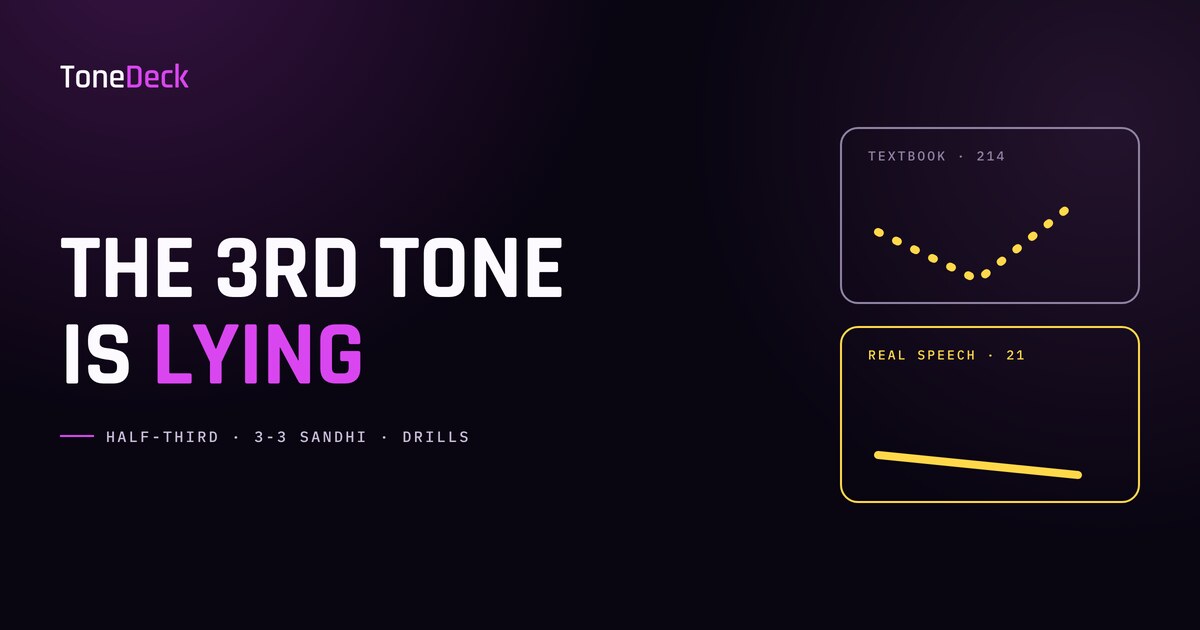
In connected speech the Mandarin third tone is usually pronounced as a low, level half-third (pitch 21), not the full dip-and-rise (214) drawn in textbooks. The full curve only appears when a third-tone syllable stands alone or ends a phrase. Before another third tone it turns into a rising tone altogether. If you have been swooping every ǎ down and back up, that is why your Mandarin sounds slow and slightly sing-song, and why native speakers sometimes hear a second tone where you meant a third. This guide fixes it.
Pinyin colours: 1st high-flat, 2nd rising, 3rd low-dipping, 4th falling, grey = neutral. Tap any word to hear it.
The textbook picture versus what you actually hear
Every beginner chart draws the third tone as a V: start mid-low, drop to the bottom, climb back to the top. The tone mark ǎ is that V in miniature. The chart is not wrong, it is just describing the citation form, the way a native speaker says the syllable when reading it in isolation from a list. Nobody speaks in isolated syllables. Inside a word, there is no time for the rise, so the tail is cut off and what remains is a short, low, slightly creaky syllable. Chinese teachers call this 半三声 bàn sānshēng, the half-third tone.
Listen to 好 on its own and then inside 好吃. In the first clip the pitch dips and comes back. In the second it stays down and the jump up belongs to chī, not to hǎo.
The three shapes of the third tone
It helps to stop thinking of the third tone as one contour and start thinking of it as one low tone with three surface forms. Which form you use depends entirely on what comes next.
Full third tone
pitch 214Alone, or at the end of a phrase when the word is stressed.
Half-third tone
pitch 21Before a first, second or fourth tone, and before most neutral tones. This is the common case.
Raised third tone
pitch 35Before another third tone. The first one is said as a rising second tone: the 3-3 sandhi rule.
The one common exception to the half-third rule is a neutral tone that comes from an original third tone, as in 姐姐 (older sister) or 想想 (have a think): there the first syllable often rises as if the sandhi rule had applied. You will pick that up by ear; do not try to memorise it.
Why the low pitch is the whole point
Once you know the rise is optional, the identity of the third tone becomes obvious: it is the tone that lives at the bottom of your range. First tone is high, second tone goes up, fourth tone comes down from high, and third tone is low. If you put the rise back in where it does not belong, the listener hears the going-up part and files the syllable as a second tone. That turns 买 (buy) into something that sounds like 埋 (bury), and makes 马 (horse) blur into 麻 (numb). Tap these pairs and concentrate on where each syllable starts: a third tone starts low, a second tone starts in the middle and moves.
A useful physical cue: a properly low third tone often goes slightly creaky, the vocal fry you hear at the end of a tired English sentence. Native speakers do this constantly. If your half-third has a hint of creak, you are in the right place. If it is smooth and musical, you are probably too high.
The 3-3 rule: two low tones cannot sit together
Two low half-thirds in a row would be hard to hear and awkward to say, so Mandarin raises the first one to a full second tone. The most famous case is the first word in every textbook: 你好 is written nǐ hǎo and said . The spelling does not change, the tone marks stay as thirds, and only the sound moves. The rule is automatic and exceptionless for two syllables, so any 3 + 3 word you learn should be drilled as 2 + 3 from the start.
With three or more third tones in a row, speakers group the syllables first and apply the rule inside each group, so 我很好 comes out as wó hén hǎo in fluent speech, while a slower speaker might keep wǒ low and only raise hén. Both are fine. Getting the two-syllable case right is what matters for a beginner; the long chains sort themselves out with exposure. The full set of rules, including how 不 and 一 change, is on the tone sandhi page.
Drill: one syllable, five contexts
Take 好 through every environment. Say each one after the audio and exaggerate the difference: the full dip alone, the flat low floor before other tones, and (in 你好 above) the rise before another third. Ten repetitions of this set does more for your third tone than an hour of reading about it.
Then go the other way: pick a third-tone word you already know and put something after it. 我 wǒ (I) is a perfect candidate because it starts thousands of sentences and is almost never said with the full curve.
How to make it automatic
Knowing the rule is the easy half. The hard half is hearing the low half-third at conversational speed and producing it without thinking. Three things move that along quickly:
- 1
Train the 2 versus 3 contrast by ear
It is the single most confused pair for English speakers, because both seem to go up. The free tone test plays real syllables and tells you immediately whether you heard a rise from the middle (2nd) or a low start (3rd).
Take the free tone test → - 2
Drill tone pairs, not single tones
The half-third only exists in pairs, so practise 3 + 1, 3 + 2, 3 + 4 and 3 + 3 as whole units. The tone pairs game does exactly this with instant audio.
Play the tone pairs game → - 3
Load up on real third-tone words
The fastest way to internalise the shapes is volume. Browse the most common third-tone words and say each one in a two-syllable word rather than alone.
Common third-tone words →
New to tones altogether? Start with Mandarin tones explained and the third tone spoke page, then come back here.
Frequently asked questions
What is the half-third tone in Mandarin?+
The half-third tone is the low, flat-ish version of the third tone (pitch roughly 21) that speakers use whenever a third-tone syllable is followed by another syllable that is not a third tone. The rise at the end is dropped. It is the most common way the third tone is actually pronounced.
When is the third tone pronounced with the full dip and rise?+
Only when the syllable stands alone or comes at the end of a phrase and carries stress, for example 好 (hǎo) said on its own as an answer. Inside words and sentences the third tone is almost always the low half-third, or becomes a rising tone before another third tone.
Why is nǐ hǎo pronounced ní hǎo?+
Because of third-tone sandhi. Both 你 and 好 are third tones, and two low third tones in a row are awkward to say, so the first one is raised to a second (rising) tone. The dictionary spelling stays nǐ hǎo; only the pronunciation changes.
Should I write the changed tone or the original tone?+
Write the original dictionary tone (nǐ hǎo, kěyǐ) and apply the change when you speak. Some beginner materials, including the coloured pinyin on this page, colour the spoken tone to make the rule visible, but the standard spelling keeps the third-tone mark.