HSK guide · Checked 23 August 2026
HSK 3.0 explained: new levels, vocabulary and the 2026 rollout
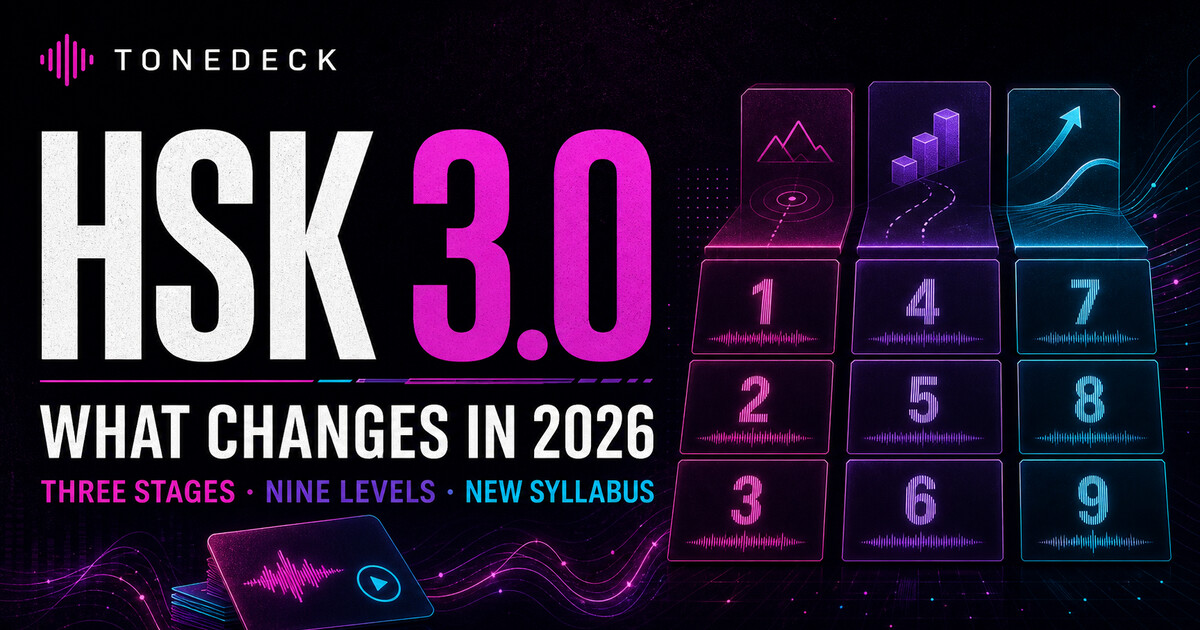
HSK 3.0 expands the familiar six-level exam into a broader three-stage, nine-level framework. It raises the language benchmarks, gives speaking and writing more weight, and adds translation at the advanced stage. The important catch is that the change is still being introduced in stages, so the test you can book may depend on your centre and date.
The short version: what changed?
Six levels became nine
Levels 1–3 form the elementary stage, 4–6 the intermediate stage, and 7–9 the advanced stage.
The targets grew
The official standard benchmarks 500 words at Level 1 and 11,092 words across the advanced Levels 7–9.
More than vocabulary
The syllabus is organised around tasks, topics, vocabulary, Chinese characters and grammar.
Productive skills matter
The framework assesses listening, speaking, reading and writing, with translation added at advanced levels.
HSK 3.0 levels and official targets
These are cumulative benchmarks from China's official Chinese Proficiency Grading Standards for International Chinese Language Education. A slash in the source table separates new items at that level from the cumulative total; the table below shows the cumulative number so levels are easy to compare.
| Level | Stage | Syllables | Characters | Words | Grammar points |
|---|---|---|---|---|---|
| HSK 1 | Elementary | 269 | 300 | 500 | 48 |
| HSK 2 | Elementary | 468 | 600 | 1,272 | 129 |
| HSK 3 | Elementary | 608 | 900 | 2,245 | 210 |
| HSK 4 | Intermediate | 724 | 1,200 | 3,245 | 286 |
| HSK 5 | Intermediate | 822 | 1,500 | 4,316 | 357 |
| HSK 6 | Intermediate | 908 | 1,800 | 5,456 | 424 |
| HSK 7–9 | Advanced | 1,110 | 3,000 | 11,092 | 572 |
A benchmark is not a promise that every item appears on one test. Use the official test syllabus and sample questions for your booked exam.
Old HSK versus HSK 3.0 vocabulary
The established six-level HSK ladder used cumulative word targets of roughly 150, 300, 600, 1,200, 2,500 and 5,000. The new standard moves those benchmarks to 500, 1,272, 2,245, 3,245, 4,316 and 5,456 for Levels 1–6, then extends to 11,092 at the advanced stage. That does not mean a current HSK 2 learner suddenly forgot Chinese. The scale changed, so level numbers are no longer a clean one-to-one comparison.
Practical takeaway
Track what you can do in listening, speaking, reading and writing, not only the number on your deck. Vocabulary totals are useful planning markers, but communication skills decide whether that vocabulary is available when you need it.
What the September 2026 trial tests
The second trial offers paper-based and internet-based formats. Its published timetable covers Levels 1–6, and candidates for Levels 3–6 must register for the corresponding speaking assessment. The official advanced HSK 7–9 test is internet-based and combines listening, reading, writing, translation and speaking in one assessment that awards Level 7, 8 or 9 according to performance.
The new HSK syllabus also frames preparation around five components: tasks, topics, vocabulary, Chinese characters and grammar. That is why memorising a list by itself is not enough preparation for the new framework.
What should you study right now?
- 1
Confirm your actual test
Ask the test centre which syllabus, format and speaking requirement applies on your date before rebuilding your study plan.
- 2
Keep your current six-level foundation
The familiar HSK vocabulary is still valuable high-frequency Mandarin and may remain directly relevant to the exam available to you.
- 3
Add output earlier
Practise speaking and writing alongside recognition. Build sentences, record answers and rehearse short task-based responses.
- 4
Use official samples
Match your timing and question practice to the current syllabus and sample questions published by Chinese Testing International.
Study the established HSK 1–6 path
ToneDeck currently organises its complete public vocabulary coverage around the widely used six-level lists. Each page adds level outcomes, topics, grammar, pronunciation priorities, a study plan and the full tone-coloured word list.
Frequently asked questions
Is HSK 3.0 already in use in 2026?+
It is in staged rollout. The official HSK site presents the new three-stage, nine-level system and has scheduled a second global trial for 20 September 2026. Because availability and syllabus use can differ by test centre and date, confirm the exact version when you book.
How many levels does HSK 3.0 have?+
Nine levels grouped into three stages: elementary Levels 1–3, intermediate Levels 4–6 and advanced Levels 7–9. Levels 7–9 are assessed through one advanced test that awards a level according to performance.
How many words are in HSK 3.0?+
The official 2021 proficiency standard sets cumulative vocabulary benchmarks of 500 words at Level 1, 1,272 at Level 2, 2,245 at Level 3, 3,245 at Level 4, 4,316 at Level 5, 5,456 at Level 6 and 11,092 across Levels 7–9.
Does HSK 3.0 include speaking?+
Speaking has a larger role in the new system. For the second global trial in September 2026, candidates registering for Levels 3–6 must also register for the matching speaking test. The advanced Levels 7–9 test includes speaking and translation sections.
Should I stop studying the old HSK 1–6 vocabulary lists?+
No. The established six-level lists remain a useful learning sequence and may still match the exam offered by your centre. Keep studying your current level, then check the official syllabus and sample questions for the exact test date you intend to book.
Official sources
This guide was checked on 23 August 2026 against the official HSK overview and syllabus, the second global trial announcement, and the Ministry of Education's GF 0025–2021 proficiency standard. Always confirm booking details with your test centre.